
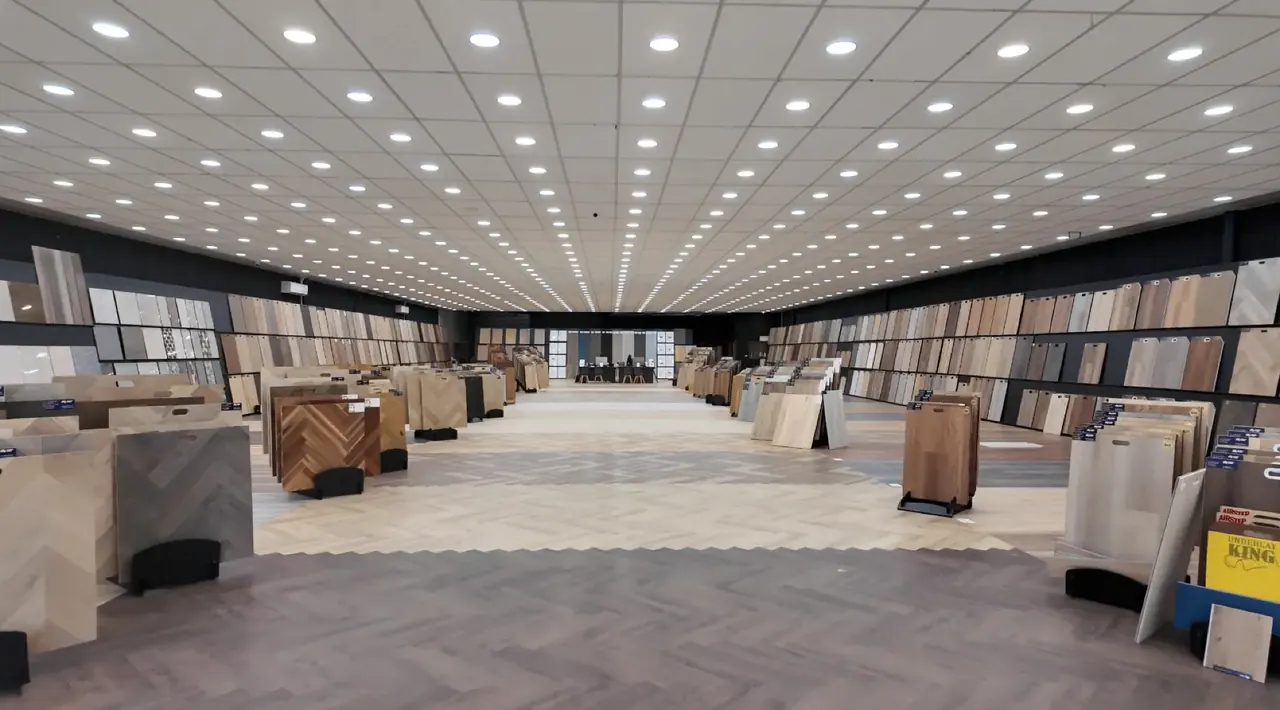
Hybrid is the clear favourite on our sales orders. Across our three company showrooms, in Dandenong, Werribee and Thomastown, it made up about 65% of the flooring lines in the 12 months to October 2026: about two in every three.
The short version. Hybrid made up about two in every three flooring lines on our sales orders in the 12 months to October 2026, the same as the year before. Laminate was next at about 15%, then engineered timber at about 10%, with carpet and tiles at about 5% each. Carpet and tiles appeared on noticeably more of our orders than the year before.
What's the most popular flooring in Victoria right now?
On our sales orders, it's hybrid by a wide margin. Here's the full mix.
| Flooring type | Share of flooring lines |
|---|---|
| Hybrid | about 65% |
| Laminate | about 15% |
| Engineered timber | about 10% |
| Carpet | about 5% |
| Tiles | about 5% |
| Vinyl plank, solid timber, carpet tiles and sheet vinyl, combined | about 5% |
Compared with the 12 months before, the big trend held: hybrid stayed at about two in every three flooring lines, while carpet and tiles appeared on noticeably more of our orders.
You're welcome to quote these figures. Please credit National Floors and link to this page.
Where do these figures come from?
We counted flooring lines on sales orders from our three company showrooms, for the 12 months to October 2026 and the 12 months before.
- What counts. Flooring lines linked to catalogued products, grouped by product category. Lines entered as free text aren't counted.
- Lines, not dollars. Each flooring product line counts once, whatever it cost.
- Rounding. Shares are rounded to the nearest 5%, so they may not add to exactly 100%.
All three showrooms are in metropolitan Melbourne, and Warragul, our newest, isn't included. Read the figures as what our customers chose, not a measure of the whole market.
Hybrid vs laminate: what's the difference?
They look alike and both click together as floating floors, but the core differs, and that decides where each works best.
Hybrid has a rigid core, often a stone plastic composite, under a printed design layer and a tough wear layer, usually with an acoustic underlay attached. The core resists water. People choose it for a timber or stone look and a surface built for busy homes, and Godfrey Hirst suggests its hybrid for kitchens, dining and open-plan living areas. For bathrooms and laundries, Preference Floors says to check local building rules first: hybrid is no substitute for a waterproof membrane.
Laminate is a printed image of timber under a hard-wearing melamine surface, over a high-density fibreboard core. Its wear layer stands up well to scratches and knocks, and it's usually the more affordable of the two: Godfrey Hirst describes it as the look of real timber "at an accessible price point".
The catch is water. The core is a wood product, and the Australasian Timber Flooring Association (ATFA) notes that even water-resistant laminate isn't classed as waterproof.
Caring for them is similar:
- Sweep or vacuum, then damp mop: water and a pH-neutral cleaner for hybrid, and a waterless laminate cleaner or a well-wrung mop for laminate, so it's dry within 15 seconds.
- Never steam mop or flood either floor, and wipe up spills promptly.
- Use felt pads under heavy furniture, and avoid rubber-backed mats, which can leave permanent marks.
- Neither can be sanded back like timber.
Where water is likely, hybrid is the safer choice. In a dry room on a tighter budget, laminate does the job well.
Is engineered timber worth it?
If you want real wood, engineered timber is the step up: a genuine hardwood top layer bonded to a multi-layered core. Godfrey Hirst says that makes it more stable than solid timber and less prone to seasonal movement, cracking and warping, and the surface can be re-sanded. It sits at the premium end of hard flooring.
It's still timber, though. ATFA notes that wood-based floors shrink and swell with humidity, so engineered timber suits living areas, hallways and bedrooms better than wet areas. Timber also typically darkens over its first few months in the light, so move rugs now and then. Care is gentle: a timber floor cleaner with a microfibre or well-wrung mop, no steam mop, and a professional for any sand and recoat.
Solid timber, part of the last group in our table, is usually sanded and coated on site. It moves with humidity too, so expect some gaps in dry weather.
When is carpet or tile the better choice?
Carpet is warm, soft and quiet, a natural fit for bedrooms, and the Carpet Institute of Australia notes it's naturally slip resistant.
Choose by the Australian Carpet Classification Scheme (ACCS) label, which rates residential carpet from one to six stars for foot traffic: at least one star for a lightly used bedroom, two for a living room and three or four for a busy hallway. For stairs, choose one labelled as suitable for them.
Vacuum at least weekly (twice a week in busy areas), blot spills with a white cloth and water, and have it professionally cleaned every 12 to 18 months, or as the maker specifies, to the standard AS/NZS 3733.
Tiles, ceramic or porcelain, are made from clay and other natural materials fired at temperatures that often top 1,200°C. The Australian Tile Council notes that ceramic tiles can be fully immersed in water without changing, take heavy foot traffic once properly laid, and clean with a sweep and a light mop. That's why they suit showers, bathrooms and laundries. Before you choose:
- Waterproofing comes first. The building code requires a shower floor to be waterproofed before the tiles go down, as Victoria's Building and Plumbing Commission explains. This is general information, not legal or financial advice.
- Ask for the slip rating in wet areas. The Australian standard for slip resistance of new floor surfaces is AS 4586.
- Tiles suit a sunny slab. The Australian Government's YourHome guide suggests tiles rather than insulating finishes like carpet, so the concrete can store the winter sun's warmth.
- Upstairs, they carry noise. Footsteps on tiles can be heard in the room below.
Vinyl plank, also in the last group, is moisture resistant too, ATFA notes.
What's the best flooring for each room?
No single floor suits every room. Here's a starting point.
| Room or situation | Usually suits | Why |
|---|---|---|
| Kitchen, dining and living | Hybrid, laminate, engineered timber | Hybrid copes with spills; laminate and timber need them wiped up quickly |
| Bedrooms | Carpet, engineered timber, hybrid | Carpet is warm, soft and quiet |
| Bathrooms and showers | Tiles | Water doesn't affect them; showers need a waterproofed floor beneath |
| Laundries and powder rooms | Tiles, or hybrid or vinyl plank where approved | Check the product's instructions and the building rules |
| Stairs | Carpet labelled for stairs | The ACCS label shows whether it suits stairs |
| Rentals, children and pets | Hybrid, laminate | Tough wear layers and simple care |
What does this mean for a flooring showroom?
For a showroom owner, the mix shows where your floor space and product knowledge should go.
- Lead with hybrid and laminate. Together they make up most of the flooring lines on our orders, so give them your strongest displays.
- Show a spread of price points, from laminate at the accessible end to engineered timber at the premium end.
- Keep carpet, tiles and timber on the floor. A whole-home customer might want hybrid in the living areas, carpet in the bedrooms and tiles in the bathroom, and carpet and tiles appeared on noticeably more of our orders than the year before.
- Know the care and installation rules. Customers will ask whether hybrid can go in the laundry. Our three months of in-store training covers product, sales, operations and the money side.
A National Floors showroom is fitted out to our tested design, with ranges from 20+ suppliers, including Godfrey Hirst, Preference, Karndean, Tarkett and Quest, plus exclusive ranges and national pricing, drop-shipped to site. Our guides to a showroom or a van and when Victorians buy new floors cover why a full range matters and the seasonal pattern.
To run a showroom in regional Victoria, see the open territories, from Geelong to Mildura, each covering roughly a 60-minute drive, or check whether your area is open in about two minutes.
Questions
What's the most popular flooring in Australia?
We can only speak for our own customers. Across our three Melbourne showrooms, hybrid made up about two in every three flooring lines on our sales orders in the 12 months to October 2026, with laminate next at about 15%.
Is hybrid flooring waterproof?
Its core resists water, so everyday spills wiped up promptly won't hurt it. It's no substitute for a waterproof membrane, though, so check the product and the building rules before using it in a bathroom or laundry.
Is laminate or hybrid better with pets?
Both work. Laminate's wear layer resists scratches well, and hybrid's water-resistant core copes better with accidents. Either way, keep claws trimmed.
Does a flooring showroom need every type of floor on display?
It helps. Hybrid and laminate do most of the work, but carpet, tiles and timber on display let you quote a whole home. Customer orders don't have to come off your shelves: in our model, they're drop-shipped to site at national pricing.
Sources
- National Floors sales orders, 12 months to October 2026, and the 12 months before: flooring lines from our Dandenong, Werribee and Thomastown showrooms
- National Floors franchise opportunity: showrooms, suppliers, training and support
- Australasian Timber Flooring Association: Wood and vinyl based flooring
- ATFA: Owner expectations for solid timber floors
- Godfrey Hirst: Hybrid, laminate and engineered timber flooring
- Godfrey Hirst: Hard flooring care guides
- Preference Floors: What waterproof means for hybrid and vinyl plank flooring
- Carpet Institute of Australia: Carpet benefits, Choosing the right carpet and Carpet maintenance
- Australian Tile Council: Benefits of tiles and Australian tiling standards
- Building and Plumbing Commission (Victoria): Waterproofing of wet areas
- YourHome: Concrete slab floors