
If you're thinking about starting a flooring business, the first big decision usually isn't which products to sell. It's what kind of business you want to run: a mobile one, where you take samples to people's homes from a van, or a showroom, where customers come to you.
Both are real businesses, but they ask very different things of the owner. This guide sets the two side by side, so you can work out which one suits you.
The short version. A van keeps your upfront commitment low, but you do almost everything yourself: finding customers, measuring, selling and often installing. A showroom needs premises, a lease, stock and a team, and in return customers can walk in, see and touch the floors, and you lead a business rather than doing every job. A franchise showroom adds a known brand, marketing and systems from day one.
What does a mobile flooring business look like?
A mobile flooring business is often one person, a van and a phone. Customers find you through word of mouth, a listing online or a builder you work with. You book a time, drive to their home with a boot full of samples, measure up, quote, and often lay the floor yourself or with a subcontractor.
That's a common way to start a small business in Australia. At 30 June 2026, the ABS counted 2,814,778 actively trading businesses, and nearly two in three of them didn't employ anyone. Many of those are sole traders who are the whole business: the salesperson, the bookkeeper and the person on the tools.
What a van does well:
- A low starting commitment. There's no shopfront and no retail lease to sign, so you can start small and grow when you're ready.
- Flexibility. You set your own hours, and you can go where the work is.
- Close to the craft. If you're a skilled installer, you spend your days doing what you're good at.
What it asks of you:
- Finding every customer yourself. Without a shopfront or a marketing budget behind you, each job depends on referrals, reviews and your own advertising.
- Wearing every hat. You measure, quote, chase payment, answer the phone and order stock, often after a full day on site.
- A limited range. Customers choose from what fits in the van, and you buy at trade prices like other small buyers.
What does a flooring showroom look like?
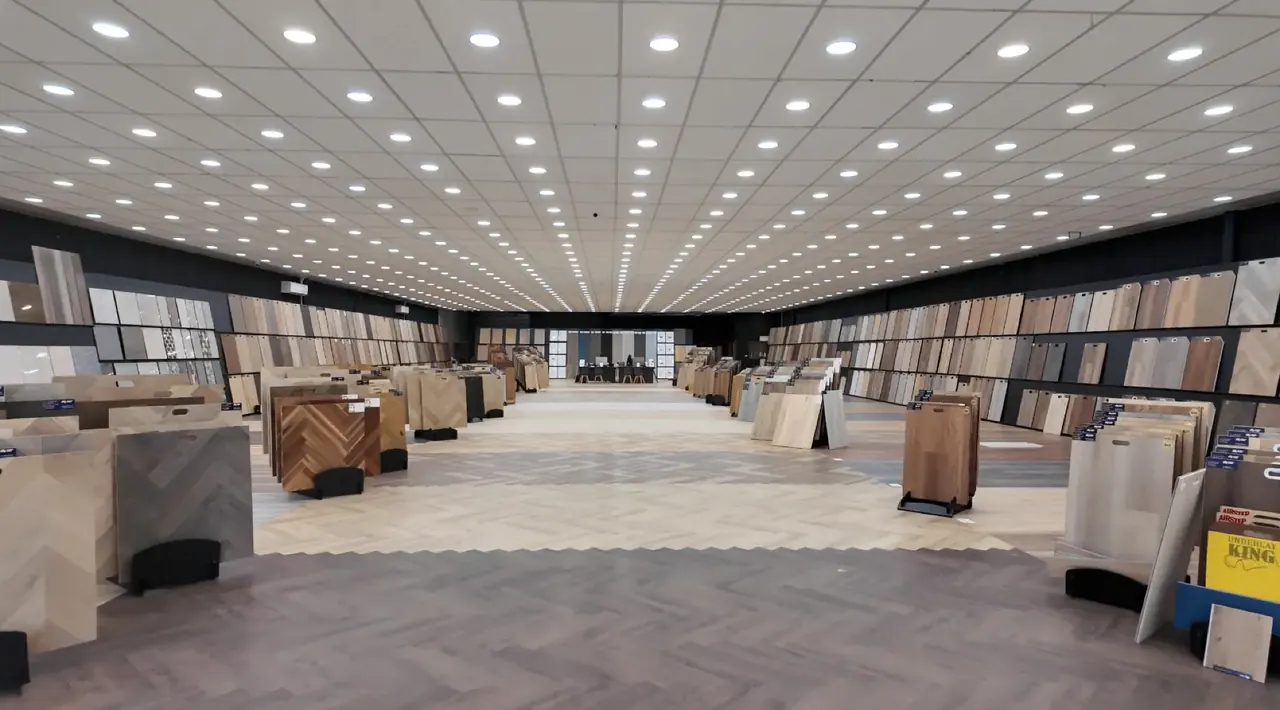
A showroom is a shop that customers visit. People come in to compare floors side by side, feel the difference between carpets, and see how a hybrid board looks in daylight. Someone on your team then books a measure, prepares the quote and schedules the install.
The owner's job changes with it. Instead of being the measurer, seller and installer, you lead a small team: you set the standard on the floor, coach your staff, watch the numbers and make sure every enquiry is followed up. Our own showrooms trade from 9am to 5pm, Monday to Saturday, and franchise owners should expect to be on the floor six days a week, especially in their first year.
What a showroom does well:
- Customers come to you. A shopfront with a recognisable name is marketing in itself, and walk-in customers are usually ready to talk about a real project.
- A full range. Customers can see every category in one place, which makes it easier to help them choose.
- A business that grows past you. With a team in place, the showroom keeps trading while you plan, hire and manage.
What it asks of you:
- Premises and a lease. A showroom needs the right site, a fit-out and, usually, a retail lease.
- Stock and people. You'll carry display stock and employ staff, with the responsibilities that come with being an employer.
- A bigger upfront investment, and the planning that goes with it.
Showroom or van: how they compare
Here's how the two models compare on the things that shape your day-to-day business. The last column shows how a National Floors franchise showroom works.
| Going it alone from a van | Starting your own showroom | A National Floors franchise showroom | |
|---|---|---|---|
| What customers see | Samples brought to their home | A showroom you design and stock | A full showroom built to a tested design |
| How customers find you | Mostly up to you | Mostly up to you, plus passing trade | Our marketing sends them to you, plus walk-ins |
| Your role | Measurer, seller and often installer | Owner, buyer, marketer and manager | Owner leading a sales team |
| Buying stock | Trade prices | Your own supplier accounts | National pricing across 20+ suppliers, drop-shipped |
| Premises | None needed | Your own lease and fit-out | Site found and assessed with you |
| Systems | Whatever you set up | Whatever you set up | Point of sale, CRM, field app and dashboards |
| Training | Learn as you go | Learn as you go | 3 months in-store, plus 10+ hours of video and 100+ pages of procedures |
| Territory | No protection | No protection | Exclusive, roughly a 60-minute drive |
| Independence | Complete | Complete | You follow a proven system and pay ongoing fees |
There's no single right answer. A van suits someone who wants to stay hands-on and keep things small. A showroom suits someone who wants to build and lead a business with a team.
What a showroom costs to set up, and what a franchise changes
Opening a showroom on your own means making every set-up decision yourself: the site, the lease, the fit-out, the opening stock, the supplier accounts, the point-of-sale system and the first marketing campaign. Each one costs money and takes time to get right.
A franchise packages those decisions. A National Floors franchise starts from $395,000 + GST, which covers the showroom fit-out, opening stock, three months of training and launch marketing. Once you're open, there's a 5% royalty and a 2% national marketing levy, both on gross sales, plus local marketing of $1,500 or 2% of sales, whichever is greater. Finance is available to approved applicants through lenders who know our model.
Our guide to what a flooring franchise costs breaks down what that investment includes and the other costs to plan for, like rent, wages and working capital.
What to know before you sign a retail lease
If you choose a showroom, the lease is one of the biggest commitments you'll make. In Victoria, most shop leases fall under the Retail Leases Act 2003, and the Victorian Small Business Commission (VSBC) explains the main protections:
- A disclosure statement first. The landlord must give you a disclosure statement and the proposed lease at least 14 days before you enter into the lease. It sets out the rent, outgoings, the term and any options to renew.
- An information brochure. The landlord must give you the VSBC's information brochure for tenants when negotiations begin.
- A minimum term. A retail lease, including any options, must be at least five years, although a tenant can ask for a shorter term.
business.gov.au suggests weighing a location on how close it is to your customers, foot traffic, parking, size and layout, zoning and room to grow. For a flooring showroom, add easy loading for deliveries and enough wall and floor space to display every category.
Get a lawyer to review any lease before you sign it. This is general information, not legal or financial advice.
Taking on staff: the employer side of a showroom
A van can stay a one-person business. A showroom almost always needs a team, and business.gov.au's guide to hiring employees lists what that involves, including:
- Giving each new employee the Fair Work Information Statement
- Paying superannuation and setting up pay-as-you-go withholding with the ATO
- Reporting pay through Single Touch Payroll
- Having workers compensation insurance
- Keeping employment records
None of this is unusual, but plan for it before you open.
Which is right for you?
Ask yourself a few honest questions:
- Do you want to work in the business or on it? If you love laying floors, a van keeps you on the tools. If you'd rather lead a team and grow, a showroom fits better.
- How do you want to find customers? Do you want to build every lead yourself, or have customers walk through the door?
- How much do you want to set up from scratch? Some people enjoy choosing every supplier and system. Others would rather start with ones that already work.
- Can you be on the floor six days a week? A showroom needs its owner there, especially in the first year.
You don't need a flooring background for a showroom. 70% of our successful managers came from other industries, and our three months of in-store training covers product, sales, operations and the money side. Our showrooms in Dandenong, Werribee, Thomastown and Warragul show what the model looks like, with Warragul our newest franchise showroom.
If you're weighing up regional Victoria, our guide to where regional Victoria is growing and the open territories, from Geelong to Wodonga, are good places to start.
Questions
Is it cheaper to start a flooring business from a van?
The upfront commitment is usually lower, because there's no shopfront, lease or display stock. The trade-off is that you find every customer yourself and do most of the work on your own. A showroom costs more to set up, and in return customers come to you and you can build a team.
Do I need a retail lease for a flooring showroom?
Usually, yes. In Victoria, most shop leases are covered by the Retail Leases Act 2003. The landlord must give you a disclosure statement at least 14 days before you enter the lease, and the term, including options, must generally be at least five years. Have a lawyer review it first.
Can I run a flooring showroom without flooring experience?
Yes. 70% of our successful managers came from other industries. A National Floors franchise includes three months of training in our trading showrooms, more than 10 hours of video training and 100+ pages of written procedures.
What does a franchise add to a showroom?
A recognised brand, a tested fit-out, national buying across 20+ suppliers, the systems our own showrooms use, $500K a year in national marketing and an exclusive territory of roughly a 60-minute drive. In return, you pay ongoing fees and follow the system. You can check whether your area is open in about two minutes.
Sources
- ABS: Counts of Australian Businesses, including Entries and Exits, July 2022 to June 2026
- Victorian Small Business Commission: Entering into a retail lease
- business.gov.au: Choose your business location
- business.gov.au: Guide to hiring employees
- National Floors franchise opportunity: investment, fees, training and showrooms