
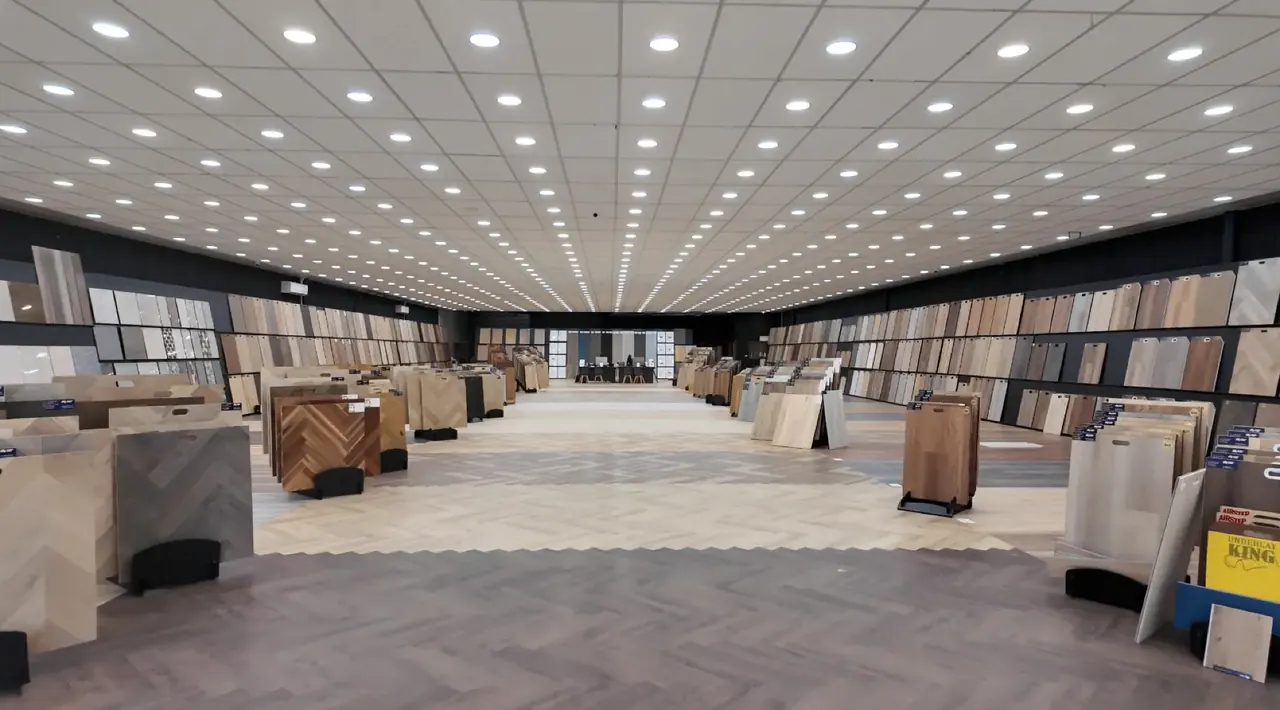
So you've chosen a showroom over a van: customers walking in, a full range on the floor, a team to lead. Now comes the bigger decision. Do you open under a franchise brand, or as an independent flooring store with your own name above the door?
Both can be good businesses for the right person. Our guide to a showroom or a van covers the first choice. This one goes deeper on the second.
The short version. A franchise showroom opens with an established brand, national marketing and pricing, ready-made systems, training and a protected territory, in return for ongoing fees and following the franchisor's system. An independent store gives you full control and no franchise fees, and you build the name, marketing, supplier accounts and systems yourself. Neither is better for everyone. It depends on what you want to build, and whose judgement you'd rather rely on.
What's the difference between a franchise and an independent business?
business.gov.au draws the line. Run your own business, and you control the products, where you buy them and how you operate. Buy a franchise, and you pay to sell an existing business's products using its brand, suppliers and systems. You follow its procedures, which it may change, and you need its agreement to make changes.
Franchise vs independent store: how they compare
Here's how they compare, with a question to ask yourself on each.
| Decision factor | Franchise showroom | Independent store | Ask yourself |
|---|---|---|---|
| Brand | Established from day one | Your own name, built over time | Build a brand, or run one? |
| Marketing | National fund plus local spend | Your own budget and skills | Could I run my own marketing? |
| Buying | National pricing, set suppliers | Your own accounts and terms | Do I have supplier contacts? |
| Systems | Supplied with the franchise | Chosen and paid for by you | Do I want to pick my own tools? |
| Training | A set program and procedures | Your experience, or learn as you go | How well do I know flooring retail? |
| Territory | Exclusive, set in the agreement | No protection, and no limits | Does a protected area matter to me? |
| Support | Coaching and peer groups | Advisers you choose | Who will I call when things go wrong? |
| Ongoing fees | Royalty, levy and local marketing | No franchise fees; you fund it all | What would each piece cost me alone? |
| Freedom | Follow the system's standards | Full control | Can I follow a system I didn't design? |
| You rely on | The franchisor and network | Yourself | Whose judgement do I trust most? |
Brand and marketing: start known, or build your own name?
A franchise showroom opens under a name customers may already know, with reviews they can read first. Across our Thomastown, Dandenong and Werribee showrooms, we have a 4.8 Google rating and 860 five-star reviews. A shared brand also means a shared reputation.
The network spends $500K a year on national marketing, and each owner spends $1,500 or 2% of sales on local marketing, whichever is greater. The Code requires a marketing fund to be kept in a separate account, with a statement each year, and you get the latest one before you sign. The ACCC notes that franchisees usually don't get a say in how the fund is spent, unless the agreement says so.
An independent builds its own name and reputation, and both belong to you. That takes time and money, and business.gov.au notes that registering a business name doesn't give you exclusive rights to it; for that, you need a trade mark. You also run your own marketing, which suits owners with the skills, or the budget to hire them.
Buying, systems and training: bought in or built yourself?
Buying. National Floors owners buy from 20+ suppliers, including Godfrey Hirst, Preference, Karndean, Tarkett and Quest, with exclusive ranges and national pricing, drop-shipped to site. The trade-off, business.gov.au notes, is that a franchisor controls where you buy, even if you could buy cheaper elsewhere. The disclosure document must set out supply restrictions and any rebates the franchisor gets from suppliers. An independent opens its own supplier accounts, stocks any brand it likes and negotiates its own terms.
Systems. Our showrooms run on point of sale, CRM and job management, a field app and live dashboards, with back office support for payables, receivables and job dispatch for a small fee. An independent chooses, pays for and connects its own tools.
Training. Our franchise owners get three months of in-store training, plus 10+ hours of video training and 100+ pages of written procedures. 70% of our successful managers came from other industries. An independent learns on the job or brings trade experience, and writes its own procedures.
Do you get a protected territory and support?
A National Floors franchise comes with an exclusive territory of roughly a 60-minute drive, set out in your franchise agreement. It's a promise between you and the franchisor, so it can't stop other flooring businesses opening nearby. An independent has no protected area, but no boundaries either.
Our franchise owners also get coaching with KPI dashboards, quarterly reviews and peer groups. An independent builds its own circle, from an accountant to a mentor, which can work very well.
What does each one cost to run?
A National Floors franchise starts from $395,000 + GST, which covers the showroom fit-out, opening stock, three months of training and launch marketing. Once you're open, there's a 5% royalty and a 2% national marketing levy, both on gross sales, plus local marketing.
An independent pays no royalty or levy, but funds its own brand and signage, website, showroom design, software, marketing and training, plus the time to set them up. Both pay rent, wages, insurance and stock. To compare fairly, price everything the fees cover as if you were buying it yourself. Our guide to what a flooring franchise costs has the detail.
How much freedom do you give up in a franchise?
More than in an independent store: that's the nature of a system. The ACCC says becoming a franchisee means following most of the franchisor's rules for running the business, and you may not always agree with them.
For a flooring showroom, that means brand standards, the ranges you carry and the processes you follow. We find the site with you and fit it out to our tested design, and our showrooms trade 9am to 5pm, Monday to Saturday. An independent decides all of that: name, look, ranges, prices and hours. If you'd chafe at a system you didn't design, that freedom may suit you better.
What are you relying on, and what are the risks?
Every business carries risk: as business.gov.au puts it, you could lose money and any assets you've borrowed against. What differs is who else you depend on.
In a franchise, you rely on the franchisor. business.gov.au lists risks unique to franchising:
- The franchisor can change what you pay and how you must operate.
- If it becomes insolvent, you may lose access to stock or the right to use the brand.
- You may not recover your costs if you can't resell or renew before the term ends.
- Termination rights often favour the franchisor.
An independent relies on its owner. No franchisor can change your fees or rules, but no one shares the load either.
What protections does the Franchising Code give you?
Franchise buyers have the Franchising Code of Conduct on their side. As the ACCC explains, you get an information statement within 7 days of showing interest, then the disclosure document, the franchise agreement and a copy of the Code at least 14 days before you sign. The disclosure document covers costs, the franchisor's solvency, future capital expenditure and contacts for current and former franchisees. After you sign, a 14-day cooling-off period lets you end a new agreement in writing and get some or all of your money back.
The ACCC also notes that the Code doesn't always protect franchisees when things go wrong. An independent has no disclosure document to read: your checks are on your own plan, lease and supplier terms. Our guide to the Franchising Code explains more.
Should I buy a franchise or start my own business?
Answer the questions in the table honestly, then do the homework:
- Take the ACCC's free online course, "Is franchising for me?": 6 modules, under 90 minutes, comparing franchising with independent small business ownership.
- Speak to at least 5 current and 5 former franchisees, as the ACCC suggests.
- Talk to independent store owners too.
- Get advice from a lawyer, an accountant and a business adviser with franchising experience.
This is general information, not legal or financial advice.
If a franchise fits, our questions to ask a flooring franchisor come next. Leaning independent? The lease and hiring sections of our showroom-or-van guide apply to any showroom, and buying a business that's already trading is a third route. Or see the open territories and check whether your area is open.
Questions
Is it better to buy a franchise or start your own flooring store?
Neither is better for everyone. A franchise gives you a brand, systems, buying and support from day one, in return for fees and following its system. An independent store gives you full control, and you build everything yourself.
Is my territory protected if I open an independent store?
No: anyone can open nearby. A National Floors franchise includes an exclusive territory of roughly a 60-minute drive, set out in the franchise agreement.
Does the Franchising Code apply to an independent store?
No. The Code covers franchise agreements. Other laws, such as the Australian Consumer Law, apply to small businesses whether they're franchised or not.
Is a franchise less risky than starting your own business?
Not necessarily. Both carry the risks of any business. A franchise takes some of the building off your hands, but adds the risks of relying on a franchisor, such as changes to fees or rules, or its insolvency.
Sources
- business.gov.au: Buy a franchise
- business.gov.au: Register your business name
- ACCC: Before you sign a franchise agreement and buy the franchise
- ACCC: Franchising course, "Is franchising for me?"
- ACCC: Information and document obligations under the franchising code
- ACCC: Franchise disclosure document
- ACCC: Specific purpose funds for franchise businesses
- ACCC: Ending a franchise agreement
- National Floors franchise opportunity